
The GLORIA Fluorine Free Concept
The expectations and requirements for fire protection products are naturally high. They should function immediately in an emergency, be intuitive to use and powerful even for laypersons, save lives, preserve health, protect values and be durable. Ideally, the extinguishing agent used should be gentle on the environment and leave hardly any consequential damage after use. In recent years, modern GLORIA wet fire extinguishers, i.e. foam or water extinguishers, met this ecological standard. While GLORIA high-performance water extinguishers have always been fluorine-free, the fluorine content of foam extinguishers of the SE+, SH and SDE types was already reduced to 0.04% in 2014.
The latter foam fire extinguishers are now being tackled: The European Commission plans to completely phase out fluorosurfactants, which are not readily biodegradable, in the next few years. The European Chemicals Agency (ECHA), together with other authorities, has drafted a regulation for the entire PFAS group of substances, which the European Commission reviewed and updated at the end of 2024. It is expected to come into force in mid-2025.
Fire extinguishers without fluorosurfactants – sustainable and future-proof
At GLORIA, we are setting a clear example for environmental and health protection: Since November 2024, we have completely stopped the production and sale of fire extinguishers with foam solutions or grease extinguishing agents containing fluorosurfactants.
This means that we are one step ahead and already comply with the upcoming EU regulation expected in 2025.
Our product range exclusively includes PFAS-free extinguishers and fillings that are not only high-performance but also environmentally friendly. In addition, we offer retrofit kits for selected models, with which existing fluorinated extinguishers can easily be converted to fluorine-free alternatives.
With this responsible step, we are making an important contribution to sustainability, and we are actively helping to reduce the burden on people and nature. Choose GLORIA – for safety with responsibility!
What does the fluorine content in the conventional foam extinguishing agent do?
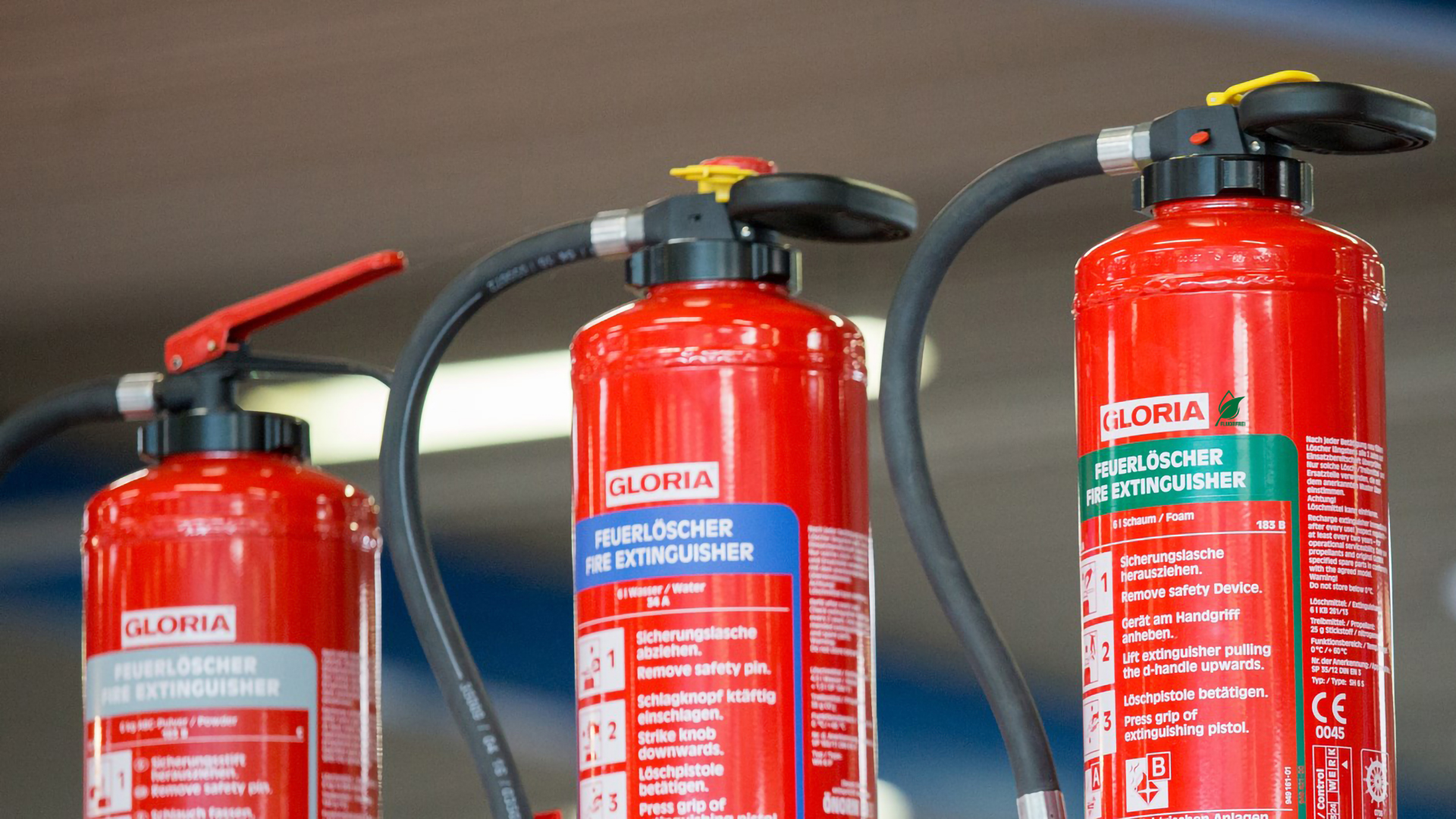
The fluorine substances give the extinguishing foam its excellent film-forming properties, which significantly increase the extinguishing effect especially on B fires (liquid fires). A very thin liquid film forms between the liquid and the foam. On A fires, the fluorosurfactants can lower the surface tension much further than other additives in the foam concentrate. This ensures that the foam penetrates better and faster into fine structures. In addition, the fluorosurfactants ensure that the foam concentrate has a repellent effect on liquids. Advantage: The liquid film is thus more stable, lasts longer and does not tear. These properties effectively prevent gas from escaping from the flammable liquid. The fluorine compounds belong to the PFAS group.
What are PFAS?
PFAS are often toxic perfluorinated and polyfluorinated alkyl substances, of which more than 4,700 individual substances are known. From a chemical point of view, PFAS are organic compounds of various chain lengths in which the hydrogen atoms have been completely (perfluorinated) or partially (polyfluorinated) replaced by fluorine atoms. They are found in countless everyday products, such as outdoor jackets, Teflon pans and pots, cosmetics and protective clothing, but also in fluorine-containing fire extinguishing agents.
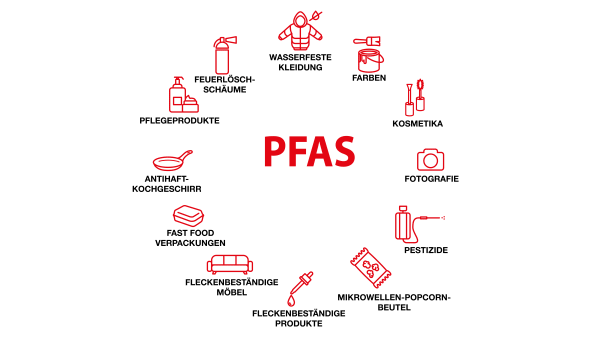
Why are foam extinguishing agents criticised?

The chemically produced substances do not occur in nature. Although they offer the advantage of being water, dirt and grease repellent, they have long been suspected of being harmful to living organisms. They rapidly enter our ecosystem via water and accumulate in humans via groundwater and drinking water, food (plants, animals and bioorganisms) or the air we breathe.
PFAS are hardly degradable, remain in the environment for a very long time and can, among other things, increase cholesterol levels and the tendency to infections, damage the liver and thyroid gland as well as the heart, probably have a carcinogenic effect and have an unfavourable influence on unborn life. A distinction is made between long-chain (and more harmful) C8 and less harmful (short-chain) C6 foams.
Even the newer generation of short-chain C6 foams, which represent the current state of the art, are now classified as being of concern. The conspicuous substance among the C6 foams whose compounds are extremely persistent in the environment is PFHxA (perfluorohexane sulfonic acid) and also belongs to the PFAS group of substances.
What does the future hold?
What can be expected in the future for extinguishing agents containing fluorine?
The future will definitely be fluorine-free. The period of use of devices containing fluorosurfactants will be restricted based on the updated draft regulation of the EU Commission.
We have summarised the details of the updated draft regulation of the EU Commission in a timeline. This can be found further down the page.
Are transitional periods foreseen for existing equipment?
The transition periods originally prepared by the ECHA were slightly adjusted by the EU Commission at the end of 2024. We have summarised these for you in a timeline. Selected GLORIA models can be converted to fluorine-free by using the appropriate retrofit kits
Current development: PFAS regulation – C6 fire extinguishing foams are also facing extinction
Five European countries (the Netherlands, Germany, Denmark, Sweden and Norway) have developed a restriction proposal that aims to cover all PFAS in other uses. This proposal was submitted to ECHA in 2023. The risk assessment foreseen in the restriction proposal on PFAS in fire-fighting foams is relevant for all PFAS. This means that it will also pave the way for the risk assessment under the broad PFAS restriction.
The European Commission has reviewed the draft regulation and updated it at the end of 2024. It is expected to come into force in mid-2025.
The core message, however, remains the ban on fluorinated solutions in fire extinguishing equipment.
For more information: updated restriction proposal by the European Commission.
A new acquisition is pending – what does GLORIA recommend?
1. Must fluorine-free foam extinguishers necessarily be used if a conventional foam extinguisher was previously available?
Fire risk and fire load must be carefully weighed up for areas to be protected for an incipient fire in the fire protection concept. In the future, the economically optimal result for the operator may be a mix of fluorine-free foam and modern high-performance water extinguishers.
2. Fire risk and fire load in workplaces according to ASR 2.2 – differentiated advice is the be-all and end-all!
Let’s think of the classic workplace in an administration building with file storage as one of many examples.
A differentiated risk assessment will predominantly identify the fire of solids in the formation phase as the highest risk. For fire class A, a water extinguisher would be considered for the area.
In the manufacturing area, flammable liquids, for example, are used in the same company. Here, the fluorine-free foam extinguisher would be predestined.
The same trigger fittings should be selected for both types in a user-friendly way.
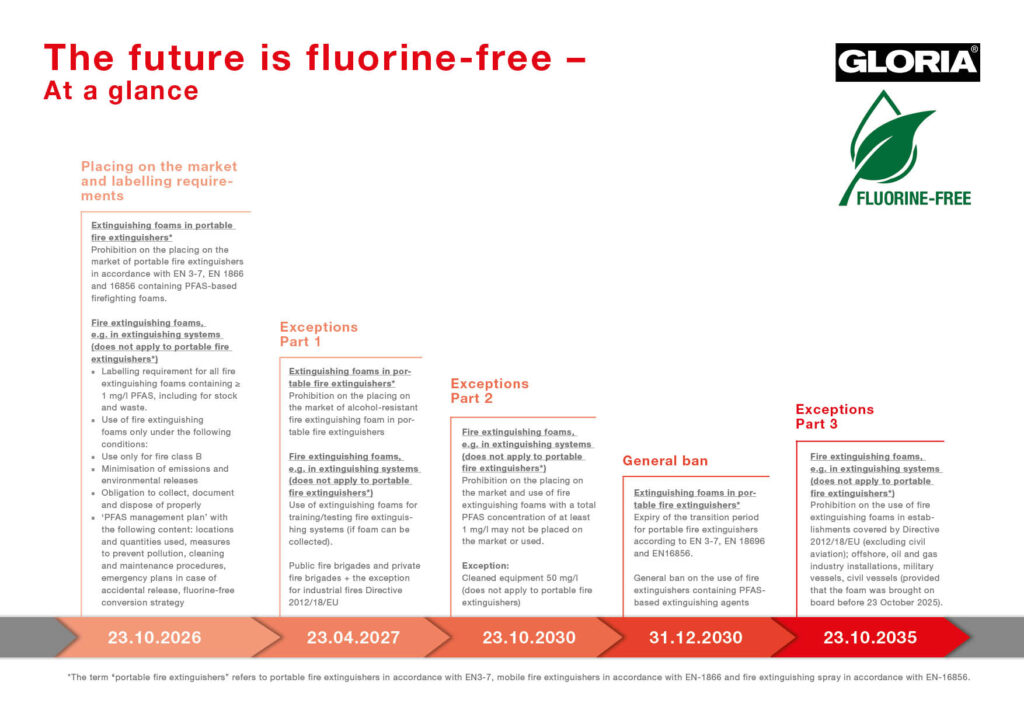
Since 2019, the European Chemicals Agency (ECHA) has been working on a general ban of fluorosurfactants in firefighting foams. The draft was published in spring 2022 and is awaiting final approval from the European Commission. If the restriction of these substances is enforced as proposed, current extinguishing agents based on C6 technology will no longer be allowed to be manufactured, used or placed on the market in the EU.
In our timeline we would like to give you a condensed overview of the next steps.
GLORIA Producthighlights
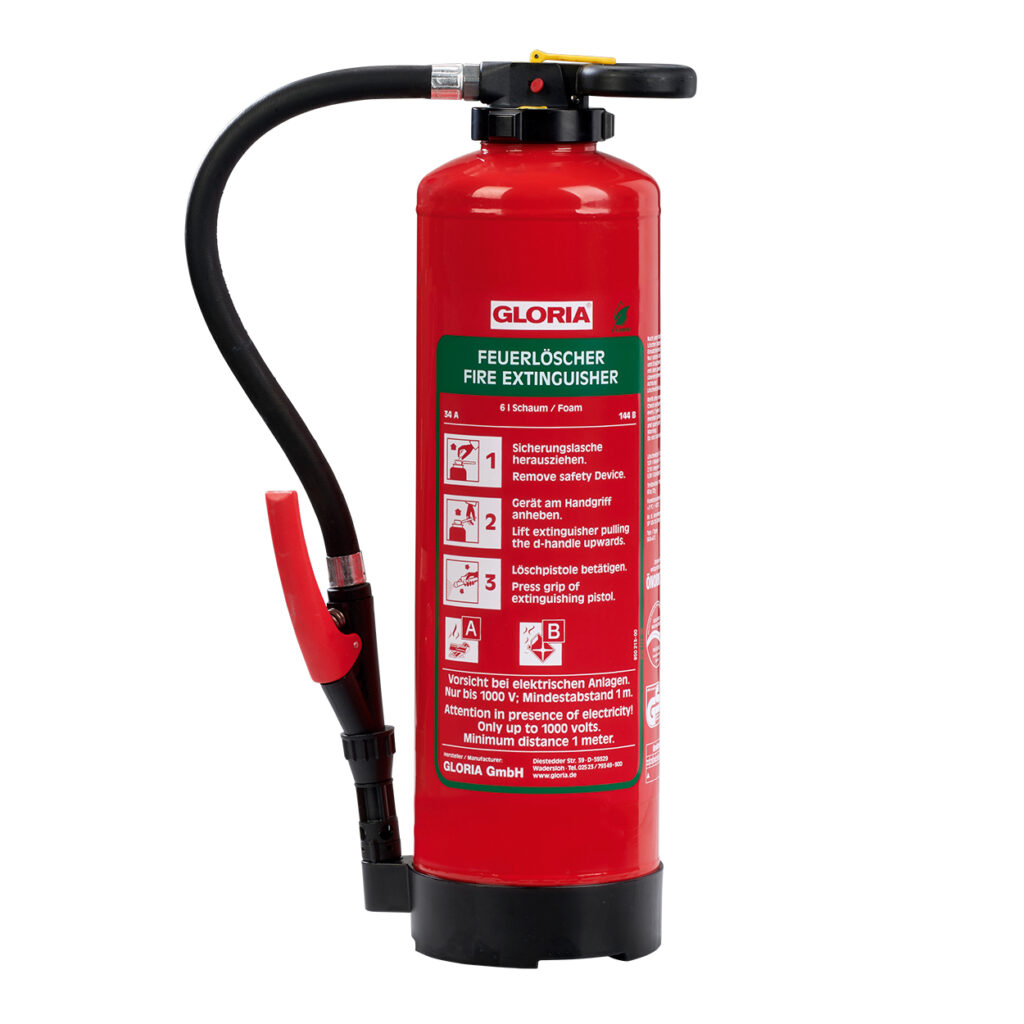
The new GLORIA fluorine-free foam fire extinguishers offer you several advantages and technical features.
GLORIA Plea
The future is fluorine-free.
Fluorine-free foam extinguishers and modern high-performance water extinguishers will shape the appearance of our workplaces, especially indoors.
Specialist planners will design fire protection concepts in a more differentiated manner and in line with environmental considerations. Risk assessments will be geared more rationally towards the fire risks and loads of individual company sections.
A mix of different extinguishing agents with the same trigger mechanisms for fire extinguishers can provide companies with tailor-made solutions that are both ecologically balanced and economical.
GLORIA guarantees you competent and forward-looking advice.